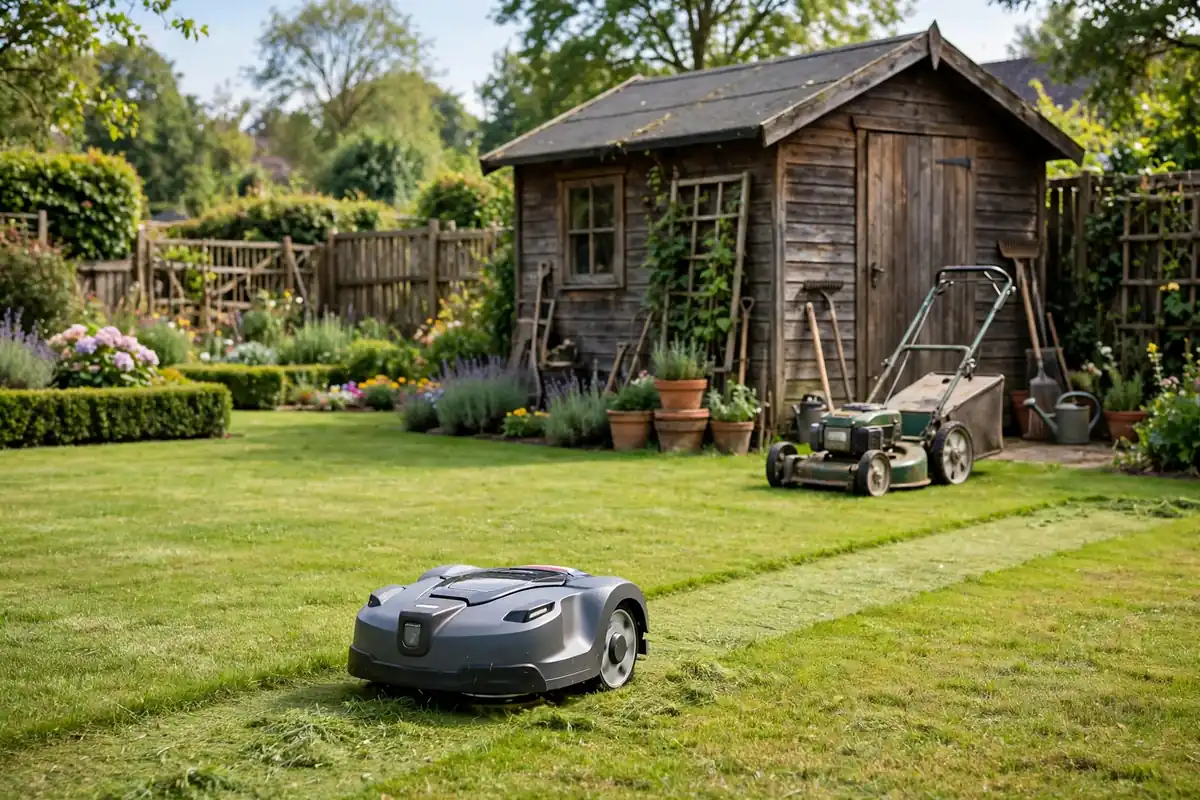
Neither option wins the robot mower vs traditional lawn mower debate for every lawn. A robot mower trades your weekly mowing time for setup and occasional upkeep, while a traditional mower keeps you in control of every pass but asks for your time and effort each time the grass grows. The better choice depends on your lawn’s size and shape, your budget, how much you enjoy mowing, and how tidy you want the grass to look between cuts. This robot lawn mower comparison covers cost, time, appearance, terrain, maintenance, noise, and storage, so you can match one of these lawn mowing options to your garden.
Robot Mower vs Traditional Lawn Mower at a Glance
| Factor | Robot mower | Traditional mower |
|---|---|---|
| Time per cut | Very little once set up | You mow the whole lawn each time |
| Upfront cost | Usually higher | Usually lower |
| Running costs | Electricity and blades | Fuel or electricity, plus servicing |
| Appearance | Frequent light trims; consistently even | Freshly cut look, with growth between cuts |
| Terrain | Best on fairly even lawns | More control on slopes and uneven ground |
| Noise | Generally quieter | Louder, especially petrol models |
| Storage | Charging station on the lawn | Shed or garage space |
How Each One Cuts the Grass
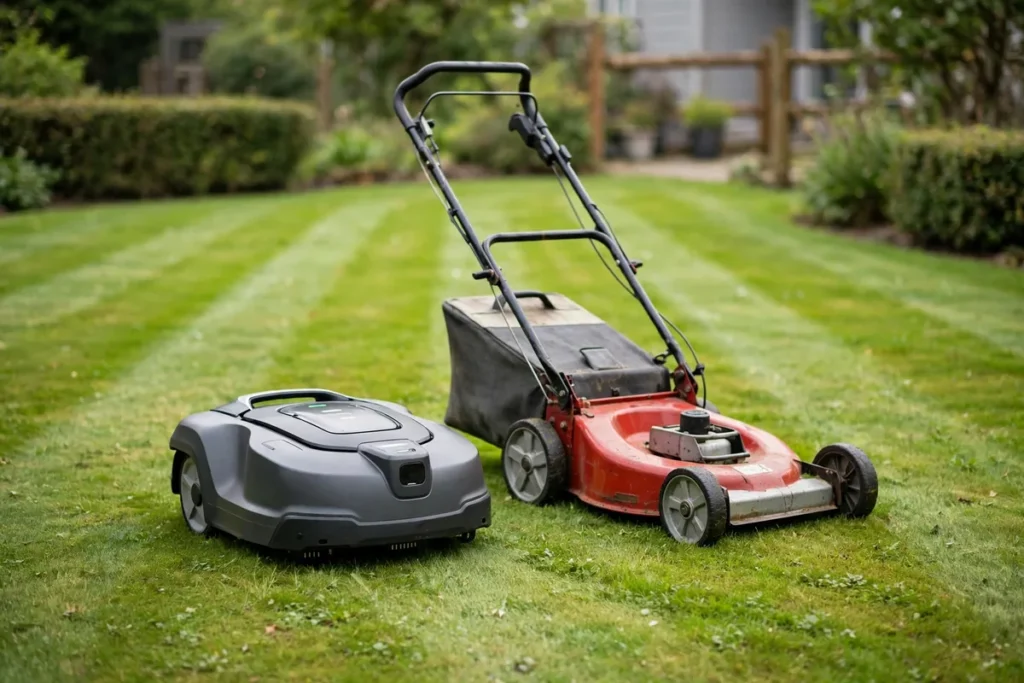
A robot mower is an automatic mower that works little and often. It leaves its charging station on a schedule, cuts a small amount of grass, and returns to charge. The fine clippings fall back into the lawn, where they break down. Because it mows frequently, the grass rarely gets long, and the lawn tends to look consistently neat.
A traditional mower — a push mower, a self-propelled petrol mower, or a corded or battery mower — cuts the whole lawn in one session. You steer around beds and trees and decide the height, direction, and pattern. You can create stripes and tackle a patch that has grown long, which a robot mower is not designed to do. The robot mower is built around routine; the traditional mower is built around control.
Upfront and Ongoing Costs
In a robotic mower vs push mower comparison, upfront cost is usually the biggest gap. Robot mowers generally cost more to buy, and the total can rise further with a boundary wire kit, a larger model, spare blades, or a shelter for the charging station. A basic traditional mower is often the lower-cost way to get started.
That does not automatically make the traditional mower cheaper over its whole life. It depends on how long you keep the machine, what you would otherwise spend on your time or on paying someone else to mow, and whether the model fits your lawn. A robot mower that is too small for the area, or a traditional mower you find too heavy to use, is poor value at any price. Running costs are modest for a robot mower — electricity and replacement blades — while a petrol mower needs fuel, oil, and servicing. Check the manual for the recommended blade type and replacement interval.
Time: Who Does the Work?
With a robot mower, the weekly job largely disappears. You set a schedule, check that the lawn is clear of toys, tools, hoses, and branches, and let the mower work. You will still trim edges and clean the mower, but you are no longer spending an afternoon pushing a mower around the garden.
With a traditional mower, you are the engine of the routine. A small, flat lawn may take only a short session, while a larger or more complex lawn takes considerably longer. For some people, that time outdoors is enjoyable exercise. For others, it is a task that gets postponed until the grass is long, which makes the next cut harder. A robot mower also takes time to install and tune at the start — laying a boundary wire, mapping the lawn, or setting schedules — while a traditional mower is ready to use almost immediately.
Lawn Appearance
A robot mower keeps the grass short by cutting often, so the lawn usually looks very even, with no piles of clippings to clear. Some owners miss the striped finish a traditional mower with a roller can produce, and a robot mower will not give you that same patterned look.
A traditional mower gives you a visibly fresh cut each time, and you can choose the direction and pattern. The trade-off is that the lawn grows between sessions, so it can look less tidy by the end of the week, especially in fast-growing weather. Both can produce a healthy-looking lawn when the cutting height is set correctly and the blade is sharp. Cutting too short, mowing when wet, or using dull blades can stress the lawn, whichever type you use.
Terrain, Lawn Shape, and Obstacles
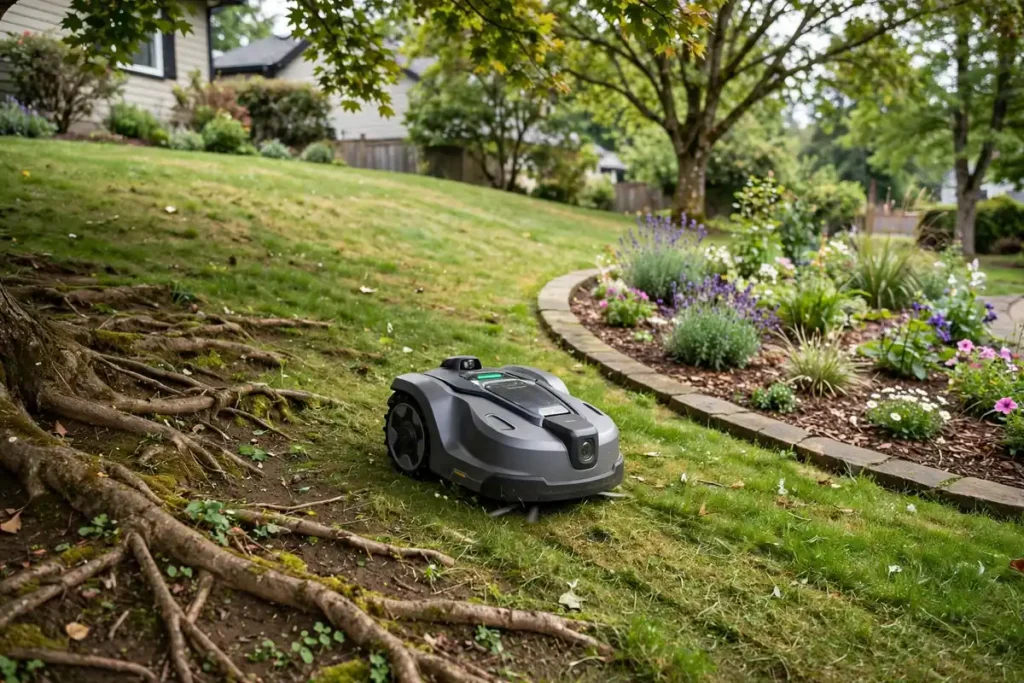
Robot mowers are happiest on lawns that suit their design: a manageable area, a reasonably even surface, and a layout they can navigate without getting stuck. Open, roughly rectangular lawns are the easiest. Lawns with narrow passages, tight corners, steep slopes, or many small obstacles need more careful planning, and some layouts may need a different model or a different approach.
Always check the specific model’s guidance on lawn size, slope, and layout before buying. A traditional mower gives you direct control on uneven ground, around beds and trees, and in awkward corners, and it is the more flexible choice if your lawn changes through the year.
Maintenance and Upkeep
Robot mower maintenance is usually light but regular: clean grass and debris from the underside and wheels, check and replace the blades, keep the charging station and contacts clean, and make sure the boundary wire or mapping stays intact. During winter, the mower and station may need to be stored in a dry, sheltered place, with the battery kept according to the manual. Never bypass a safety feature or sensor to keep the mower running.
Traditional mower maintenance depends on the type. A petrol mower needs oil checks, fuel care, and blade sharpening, and should be serviced according to the manual. A battery mower needs its battery charged and stored correctly. A corded mower is simpler, but its cable must be checked for damage. Neither type is maintenance-free, so choose the routine you are more likely to keep up with.
Noise, Neighbours, and Storage
Robot mowers are generally quieter than petrol mowers, so they can often run earlier or later in the day. Even so, check local rules and be considerate of neighbours, especially at night or very early in the morning. A battery or corded traditional mower is quieter than a petrol model, although still louder than most robot mowers.
Never let children or pets near a mower while it is running, and keep hands and feet away from the blade area. Robot mowers have safety sensors, but those are not a substitute for supervision and for keeping the lawn clear. For storage, a robot mower needs a charging station on or beside the lawn, with access to power and a level, sheltered spot. A traditional mower needs shed or garage space, and a petrol model also needs safe fuel storage away from ignition sources.
Robot Mower Pros and Cons
Robot mower pros: frees up your time once set up; keeps the lawn consistently short; generally quieter than a petrol mower; little to clear away; useful if mowing is physically difficult, provided the lawn suits the model.
Robot mower cons: higher upfront cost, plus installation and accessories; needs setup and a charging station; less suited to uneven lawns, steep slopes, or complex layouts; cannot create stripes or clear long grass; still needs blade changes, cleaning, and edge trimming.
Traditional mower pros: lower upfront cost; full control over height, direction, and pattern; handles uneven ground and awkward corners; can tackle long grass and create stripes; ready to use with little setup.
Traditional mower cons: takes your time and effort every time; petrol models are noisy and need fuel and servicing; the lawn grows visibly between cuts; needs shed or garage space; mowing can be postponed in bad weather.
Which One Suits Your Lawn?
Choose a robot mower if your lawn is fairly even, within the size the model is designed for, and free of complicated obstacles, and if your main goal is to stop spending time mowing each week. It also suits households where mowing is physically difficult, where the garden is used often and needs to look tidy most days, or where a quieter mower matters. Be honest about the setup: if you are willing to plan the layout and keep up with blade changes and cleaning, a robot mower can work very well.
Choose a traditional mower if you want full control, have a lawn with slopes, uneven ground, narrow passages, or many obstacles, or if you enjoy mowing and want the freshly cut, striped look. It also makes sense if your budget is limited or your lawn changes through the year. A battery or corded model can be a good middle ground if you want a quieter traditional mower without the fuel and servicing of a petrol model.
Before you buy either type, measure your lawn, note the slopes and obstacles, check where power and storage are available, and read the manual for the specific model you are considering.
Conclusion
A robot mower offers consistency and free time in exchange for a higher upfront cost, careful setup, and a lawn that suits it. A traditional mower offers control, flexibility, and a lower starting price in exchange for your time and effort each week. The best choice is the one that fits your lawn, your budget, and how you actually live in your garden. Compare the options against your own lawn — not someone else’s — and choose the mower you will be happy to live with for years.
Frequently Asked Questions
Is a robot mower better than a traditional mower?
Not universally. A robot mower is better for hands-off, frequent mowing on a suitable lawn, while a traditional mower is better for control, uneven terrain, and long grass. The choice depends on lawn size, shape, slope, budget, and how much time you want to spend mowing.
Can a robot mower replace a push mower completely?
Often, but not always. A robot mower can handle the main lawn, but many owners still need a traditional mower or a strimmer for edges, narrow corners, and areas the robot cannot reach. If your lawn is simple and open, a robot mower may be enough on its own.
Does a robot mower cut as well as a traditional mower?
It cuts differently rather than better or worse. A robot mower makes frequent, light cuts that keep the grass evenly short, while a traditional mower makes a single, more visible cut and can produce stripes. Both can give a good finish if the blade is sharp.
Are robot mowers worth the extra cost?
They can be, if you value the time saved and your lawn suits the model. The extra upfront cost buys automation and regular mowing, but it also brings installation and blade replacement. If you enjoy mowing or have a complex lawn, a traditional mower may offer better value.
Can a robot mower handle slopes and uneven ground?
Some models can, within the limits in their manual, but slopes and uneven ground are among the main reasons a robot mower may not suit a lawn. Check the model’s slope guidance and lawn size rating before buying.