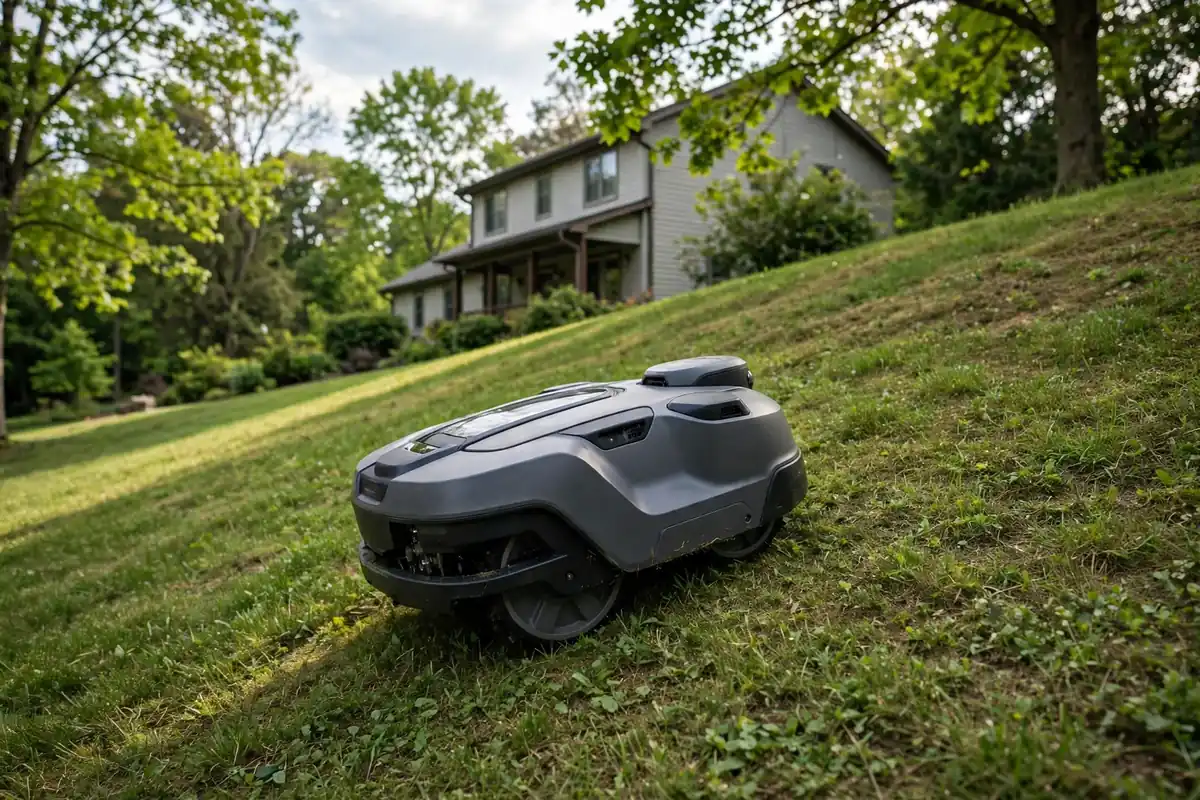
A robot mower for sloped lawn use can take a tiring weekly job off your hands, but a slope changes how a mower works. Traction, turning, stopping, and returning to the charging station all become harder when the ground is not flat. The right choice is not the model with the biggest number on the box. It is the model whose rated capability, wheels, and layout match your actual slopes — in dry and wet weather, uphill, downhill, and across the slope. This guide explains slope ratings, travel direction, wet grass, and terrain changes. It gives no universal slope limit, because there is not one: models are rated differently, and the only reliable limit is in the manual.
Start With Your Lawn, Not the Brochure
Walk your lawn as a small wheeled machine would. A slope that feels easy to walk up can still be demanding for a mower, especially when grass is damp, soil is loose, or the surface changes suddenly. Measure the steepest sections, not just the broad middle of the hill. A long board and spirit level, a smartphone inclinometer on a flat board, or a rise-over-run measurement can give a useful picture. The steepest part is often a short bank, a dip near a path, or a drainage swale.
Note where each slope is, how long it runs, and what is at the top and bottom. A short bank with flat grass above and below it differs from a long slope running into a fence, wall, pond, or road. Note surface changes — grass to gravel or paving, a tree root, a kerb, or a step — and areas that stay wet after rain. The mower must also reach the slope, turn on it, leave it, and return to its charging station, so a rough sketch will help when you plan the boundary wire or mapping run.
How to Read Robotic Mower Slope Capability
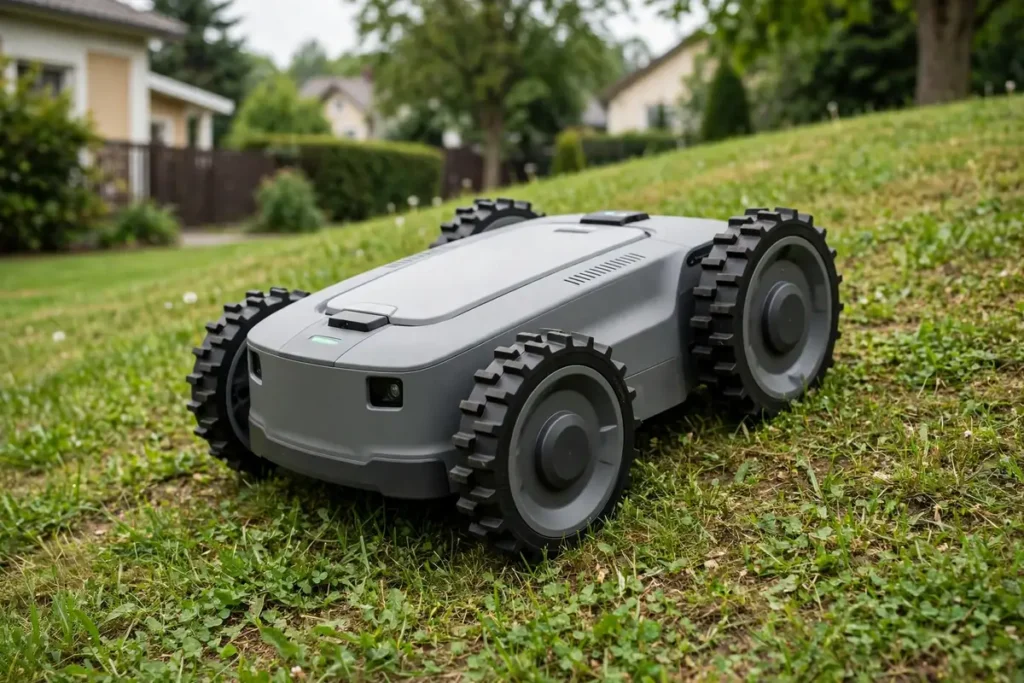
Manufacturers describe robotic mower slope capability in different ways. Some give a maximum gradient as a percentage, others in degrees. Some give separate limits for slopes inside the mowing area and at the boundary, or for climbing and for mowing across a slope. Do not assume two numbers from two brands mean the same thing.
Percent and degrees are not interchangeable
A percentage and a degree figure describe the same hill in different units, and the numbers are not the same: a 20 percent slope is not a 20-degree slope. When comparing models, convert figures to the same unit, or compare each figure against your own measured slope in the same unit. The manual should say which unit it uses and how the figure was defined. If it does not, ask the manufacturer or retailer before relying on it.
Maximum slope is not the same as comfortable working slope
Robot mower slope limits are limits, not promises of good everyday performance. A maximum slope specification usually describes the steepest gradient the mower is designed to handle under the manufacturer’s test conditions — often dry, short grass on firm ground, with a full battery. Your lawn may not match: long grass adds resistance, wet grass reduces grip, and worn blades or tyres, a low battery, or soft soil can all reduce performance.
A mower close to its rated limit has little margin when conditions change. If your steepest slope is near a model’s maximum, it may technically be rated for it and still slip, leave uncut patches, or stop on a damp morning. Look for headroom: a model rated well above your steepest slope is more likely to cope when grass is wet or ground is soft. If your slope is at or beyond the rating, do not buy on hope — consider a different model, layout, or way of mowing that section.
Direction of Travel Changes Robot Mower Hill Performance
How a mower moves matters as much as how steep the slope is. Climbing demands grip and power, as the drive wheels push the mower uphill without spinning. Descending demands control, as it brakes and steers without sliding. Crossing demands stability and steering, so it holds a straight line rather than drifting downhill. The balance between these depends on the lawn’s shape and the boundary or map: a long, narrow slope may force repeated up-and-down travel, while a wide slope may allow more cross-slope travel.
Wet Grass and Mower Traction on Slopes
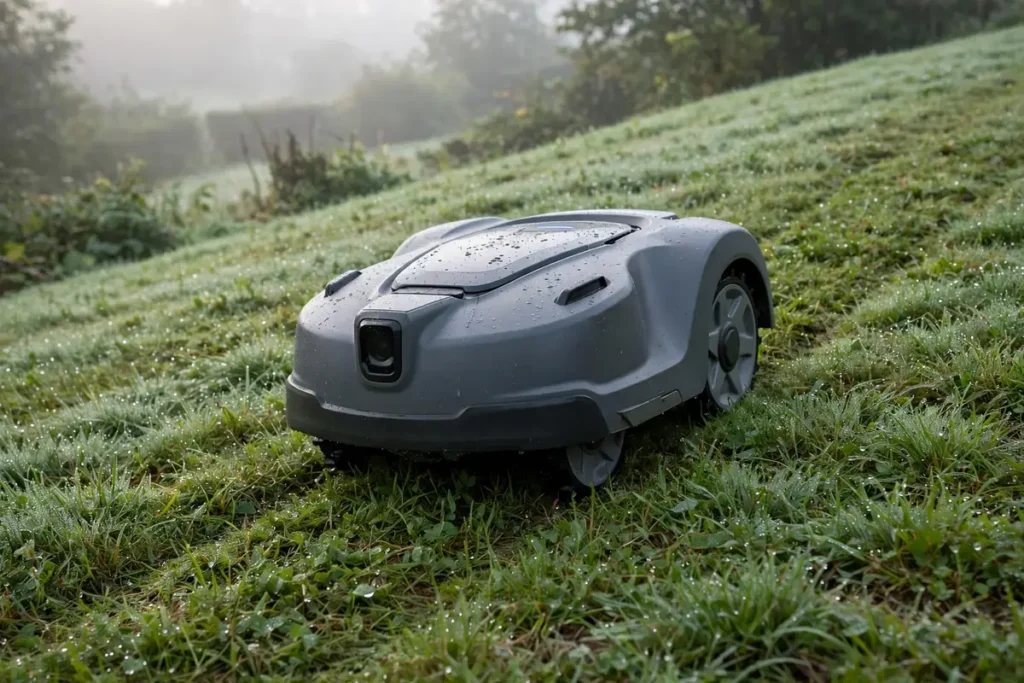
Traction is the limiting factor on most slopes: a mower can have enough power and still fail if its wheels cannot grip. Wet grass is the most common reason a mower that worked on a dry day struggles the next morning. Wet grass is slippery, wet soil is softer, and both reduce grip. Dew, rain, watering, and shaded damp areas have a similar effect. Wheels may spin without moving the mower, or it may slide when turning or stopping. Wet grass is also heavier and can clog the deck, adding load as grip falls.
Some features help mower traction on slopes, but none removes the need to respect the rated limit. Larger or wider drive wheels spread weight and can improve grip on soft ground. Deeper tread or spiked tyres can bite better than smooth tyres, though they can mark a soft lawn. Four-wheel drive helps by driving more wheels, and a lower centre of gravity aids stability when crossing a slope. Extra weight can press tyres down but also makes stopping downhill harder. Use these features to understand how a model achieves its rating, not to override it, and keep tyres clean and in good condition.
Terrain Transitions and Edges on a Robot Lawn Mower Incline
A slope rarely stands alone: it meets paths, patios, steps, retaining walls, and flower beds, and those transitions are where a mower can lose traction, get beached, or slip out of its area. A small lip where a path meets grass can stop wheels gripping as the mower climbs. A dip at the bottom can trap it. A tree root, rock, or soil ridge can lift one wheel off the ground just when traction is needed most. Walk the transitions as well as the slopes, and consider smoothing, filling, or edging a rough transition before installation.
Choosing a Robot Mower for Sloped Lawn Safely
Use this table as a checklist when comparing models. It is not a ranking and does not replace the manual; it helps you compare like with like.
| What to check | Why it matters | What to look for |
|---|---|---|
| Maximum slope rating | Sets the hard limit | Figure, unit, and whether it covers climbing, crossing, and boundary slopes |
| Headroom above your slope | Gives margin for wet or long grass | Rating comfortably above your measured slope |
| Travel direction and turning | Climbing, descending, and turning stress grip differently | Guidance on patterns, turning, and boundary slopes |
| Drive and tyre design | Affects grip on grass and soft ground | Wheel size, tread, four-wheel drive |
| Wet-weather behaviour | Traction falls sharply on wet grass | Rain sensor, wet-grass warnings, wet-weather limit |
| Charging station placement | The mower must dock safely on low battery | Flat ground, flat approach, clearance in front |
| Boundary and edge guidance | A slip at an edge is more serious | Distance from drops, walls, and water |
Follow these steps: measure your slopes and note wet areas and transitions; shortlist models rated comfortably above your steepest slope; read the manual, not just the product page; check the drive and tyres without using them to override the rating; put the station on flat ground and plan turns away from the steepest ground; and keep a safe margin from drops and water. If in doubt, ask the retailer or manufacturer to explain the rating. If no model in your budget has enough headroom, the steep section may be better mowed with a walk-behind mower or strimmer while the robot handles the flatter parts.
Safety Cautions for Sloped Lawns
Read the safety guidance in the manual before installation, and do not bypass safety features to make a mower cover a slope it was not designed for. Do not disable lift, tilt, or slip sensors: they stop the blades or the mower if it tips, lifts, or loses control. Do not use a mower beyond its rated limit, keep people and pets clear while it works on a slope, and do not push, lift, or redirect it while it is moving. If it repeatedly slips or reports errors, stop and check the troubleshooting guidance, the tyres, and the ground.
Conclusion
Choosing a robot mower for a sloped lawn is less about finding the highest slope number and more about matching a mower to your actual ground. Measure your slopes, look for headroom above the steepest section, and read the manual to understand what the rating covers. Plan the station on flat ground, keep a safe margin at edges and drops, and avoid mowing a wet hill. If the numbers do not add up, choose a different model, change the layout, or keep the steepest section for another tool.
Frequently Asked Questions
What does a robot mower slope rating actually mean?
It is the manufacturer’s stated limit for a model, usually as a percentage or in degrees, for the steepest gradient it is designed to handle under the manual’s conditions. It is not a guarantee of good performance in all weather, on all grass, or in every direction. Check how it is defined and whether it differs at the boundary or in wet grass.
Can a robot mower handle wet grass on a slope?
Wet grass reduces traction, so a slope that is easy when dry can be difficult when wet. Many mowers slip, leave uncut patches, or stop on a wet slope. Check the manual’s wet-weather guidance and rain sensor, and schedule mowing later in the day, after dew has dried, avoiding slopes during or just after rain or watering.
Is it better to mow up and down a slope or across it?
There is no single best direction for every lawn. Climbing demands grip and power, descending demands braking and control, and crossing demands stability to avoid drifting downhill. The best layout depends on the lawn’s shape, the slope’s length, and where turns happen. Plan turns on flatter ground and follow the manual.
What should I do about the steepest part of my lawn?
Measure it and compare it with the rated limit in the manual, allowing headroom for wet grass. If it is at or beyond the rating, do not rely on the mower. Consider a model with a higher rating and enough headroom, a layout that keeps the mower off that section, or mowing it with a walk-behind mower or strimmer.
Where should I put the charging station on a sloped lawn?
On flat, firm ground with a flat approach in front of it, following the clearance in the manual. Avoid the top or bottom of a steep slope, where the mower would climb or descend to dock, and avoid places where water runs after rain. Any slope it must cross to return needs to be well within its capability.
How can I improve traction on a slope?
Keep tyres clean and in good condition, keep blades sharp, and avoid mowing when grass is wet. Choose a model whose drive and tyres suit your ground, with a rating that has headroom above your steepest slope. Do not disable safety sensors, add weights, or modify the mower; if it still slips, change the layout or mowing plan instead.