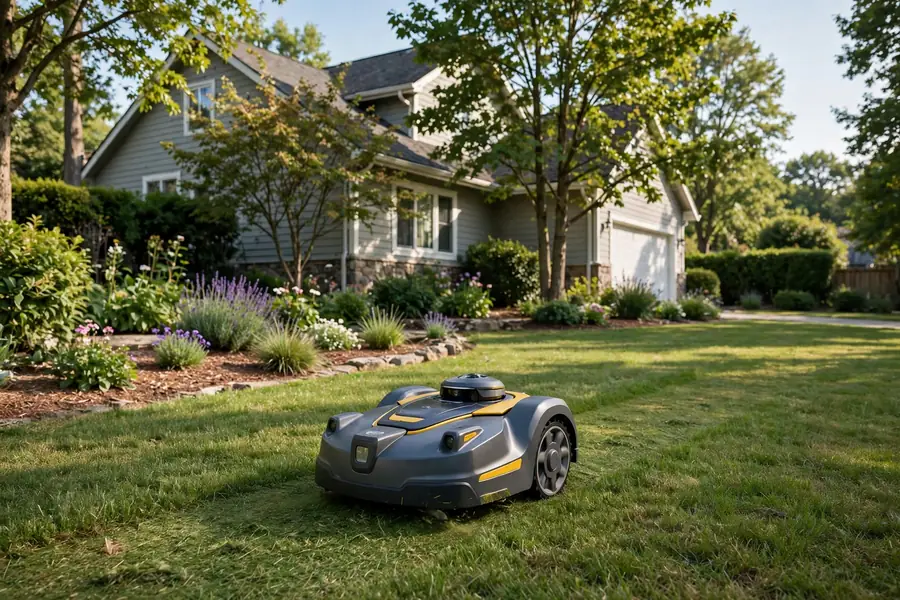
How much lawn can a robot mower handle? It can handle the lawn area its manufacturer rates it for, provided the lawn is reasonably open, the mower can run on its normal schedule, and conditions are not unusually difficult. A headline rating is a useful starting point, not a guarantee for every yard.
That matters because robot mowers work differently from walk-behind and riding mowers. They do not cut a whole lawn in one fast pass. They trim a little grass often, return to charge, and go out again. So robot mower lawn capacity is about how much ground a mower can cover, day after day, while keeping grass at a steady height. This guide explains what a manufacturer rating means, how mowing capacity per day works, and why shape, obstacles, growth, slope, and weather can shrink real-world capacity — and how to estimate the robot mower yard size you need before you buy.
What a Manufacturer’s Area Rating Really Means
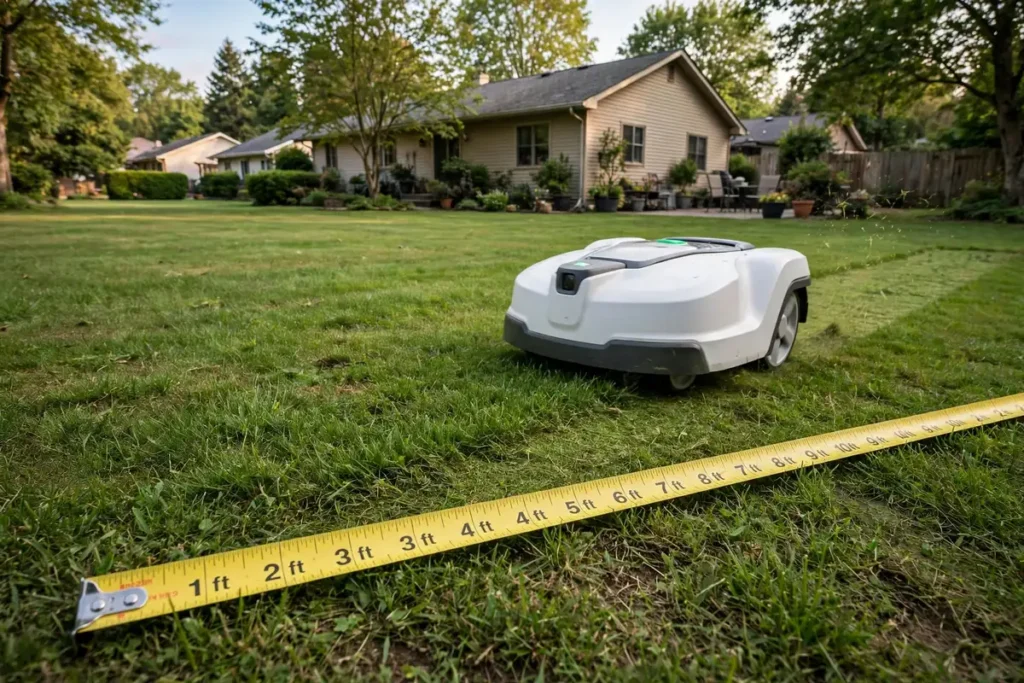
A manufacturer-rated area is the largest lawn the maker says a model is designed to maintain under its stated test conditions. It is sometimes described as robotic mower coverage area, and it is usually a total lawn area rather than what the mower cuts in one session. Treat the rating as a limit for regular maintenance, not a promise that the mower will finish any lawn of that size in one afternoon. Most robot mowers keep grass short by mowing frequently; if the grass is already long, the mower may need several sessions to catch up.
Ratings vary a great deal between models, and the rating alone does not tell you how a mower handles narrow passages or slopes. So treat the rating as a ceiling, not a target to match exactly, and always check the specific model’s manual for its rated area, cutting height range, and slope limits.
How Much Lawn Can a Robot Mower Handle Over Time
A typical robot mower follows a cycle: leave the charging station, mow for a period, return to charge, and go out again if the schedule allows. Some mow in a random pattern, changing direction at a boundary or obstacle. Others follow a planned route using boundary wire, GPS, cameras, or other navigation aids. Either way, coverage builds up over hours and days, not in a single straight pass.
Because the mower cuts little and often, it can keep grass at a consistent height without collecting clippings. This works well when the mower can run regularly, and less well when it is stopped for long periods, because grass keeps growing while it waits. Daily capacity is therefore shaped by running time, charging time, cutting width, and travel speed: a mower that runs longer, charges faster, or cuts a wider path can cover more ground, while one that spends a lot of time turning or working around obstacles will cover less. Restrict it to a few hours a week and its effective capacity falls, even if the headline rating looks generous.
Why Real-World Capacity Can Differ From the Headline Rating
A headline rating is usually based on favourable conditions: a fairly open lawn, moderate growth, and a mower on a normal schedule. Real lawns are rarely that simple, and the factors below can change how much lawn a mower can comfortably maintain.
Lawn shape and layout
A square or rectangular lawn is easier to cover than a lawn with the same area but a complicated shape. Long, narrow strips, L-shaped areas, separate front and back lawns, and lawns divided by paths or driveways can all slow a mower down. Narrow passages are a particular challenge: a mower needs enough width to pass through and turn without constantly bumping into edges. Check the manual for minimum passage width. Separate zones also add travel time that is not spent mowing.
Obstacles, trees, and garden features
Trees, flower beds, ponds, play equipment, garden furniture, and raised beds reduce the open mowing area and add edges and tight corners to work around. A lawn with many obstacles takes longer to cover than an open lawn of the same size, because the mower must slow down, turn, and navigate around each feature. If your lawn has many obstacles, allow extra capacity rather than choosing a model rated exactly for your total lawn area. Robot mowers also generally leave a small uncut strip along fences, walls, and edging, because the blade does not reach right to the boundary.
Grass growth rate
Grass does not grow at a steady rate all year. In spring and early summer, warm weather and rain can cause rapid growth; in hot, dry spells, growth may slow. Shaded, fertilised, and irrigated lawns can also grow faster than dry, sunny areas. Capacity is a balance between how fast grass grows and how fast the mower can trim it: if growth speeds up, the mower needs to run more often or for longer, and if it cannot — because of a limited schedule, charging time, or rain delays — the grass can get ahead of it.
Slope and uneven ground
Slope is one of the clearest reasons why robot mower maximum lawn size can be misleading. A model may be rated for a certain area on flat ground, but have a separate slope limit, often expressed as a percentage or an angle. Exceeding that limit can cause slipping, poor traction, uneven cutting, or the mower stopping for safety reasons. Even slopes within the limit can reduce capacity, because a mower climbing a slope uses more battery power and moves more slowly. Before buying, walk your lawn, note steep sections, and compare them with the slope guidance in the model’s manual. Do not disable safety features or modify a mower to climb slopes beyond its design.
Weather and interruptions
Rain, very wet grass, frost, and extreme heat can all interrupt mowing. Some models have a rain sensor and will pause in wet weather, returning to the charging station until conditions improve. A few rainy days in a row can create a backlog: the mower returns to taller grass and needs extra time to catch up. Everyday interruptions matter too — children playing, pets, garden work, and watering can all pause mowing — so a realistic schedule should allow for them rather than assuming non-stop running.
How to Estimate the Lawn Size You Need
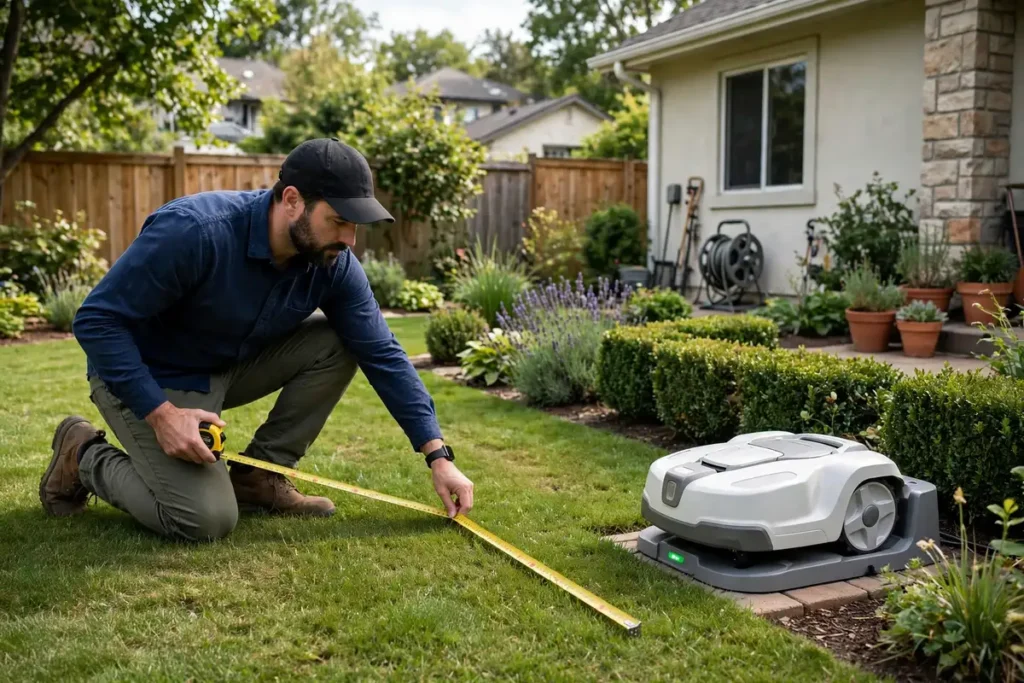
Start by measuring your actual mowable lawn, not your whole property: paths, driveways, patios, beds, and buildings are not lawn. Break the lawn into simple shapes such as rectangles and triangles, measure each section, and add them together. If you use a satellite or mapping tool, use it as a rough check, not as your only measurement.
Once you have a measured area, compare it with the manufacturer’s rating, but do not treat a close match as enough. Choose a model rated for more than your measured area, so shape, obstacles, slope, growth, and weather do not push it to its limit. An open, flat, rectangular lawn needs less margin than a steep, divided, obstacle-filled one.
| Factor | Why it reduces effective capacity |
|---|---|
| Lawn shape | More turning, travelling, and missed edges |
| Obstacles | Slower navigation and more edge work |
| Growth rate | Mower must run more often to keep up |
| Slope | Slower movement, more battery use, traction limits |
| Weather | Lost mowing time and a backlog to clear |
| Schedule | Less time available for the mower to work |
Use the table as a checklist, not as a formula. If several factors apply, allow more headroom. The goal is not to buy the largest mower available, but one that can keep up on a normal week, not just a perfect one. Area is only one limit: before you decide, also check the manual for maximum slope, minimum passage width, cutting height range, and whether it needs a boundary wire or uses another navigation method.
When a Lawn May Be Too Large for One Robot Mower
Some lawns are simply too large, too steep, or too divided for a single robot mower to maintain comfortably — a sign the workload exceeds what one machine can cover on a realistic schedule. Warning signs include a measured area close to or above the model’s rating, several difficult factors from the table above, and a schedule that leaves little running time. In those cases, consider a larger-rated model if one suits the terrain, split the lawn into zones with separate mowers, or keep a conventional mower for the most difficult areas and use a robot mower for the main open lawn. If you are considering more than one mower, check whether they can work side by side without interfering with each other’s signals or boundaries.
Conclusion
So, how much lawn can a robot mower handle? It can handle the area it is rated for, under the conditions its maker describes — and it can handle less when the lawn is awkward, steep, fast-growing, or frequently interrupted by weather. The headline rating is a starting point, not a promise for every garden. Measure your mowable lawn, look honestly at its shape, obstacles, slope, and growth, and choose a model with enough headroom to cope on an ordinary week. For more help, start with the Robot Mower Buying Guides and the Robot Mower Guide homepage.
Frequently Asked Questions
How much lawn can a robot mower handle in a day?
There is no single figure for every model: mowing capacity per day depends on running time, charging time, cutting width, speed, and time spent turning or navigating obstacles. A mower that runs longer, charges faster, and works on an open lawn will cover more in a day than the same mower on a divided lawn.
Is the manufacturer’s area rating the same as the maximum lawn size?
In most cases, the rating is the maximum lawn size the model is designed to maintain regularly, under the conditions stated by the manufacturer. It is not a guarantee that the mower will cope if the lawn is steep, narrow, or fast-growing, so allow extra headroom if your lawn is close to the rating.
Does lawn shape affect robot mower coverage?
Yes. Shape has a large effect on robotic mower coverage area: a square, open lawn is easier to cover than a lawn of the same size that is L-shaped, split into zones, or crossed by narrow passages. Obstacles and tight corners add turning and navigation time, reducing the area a mower can comfortably maintain.
Can a robot mower handle a sloped lawn?
Some models can handle gentle slopes within their stated limit, but limits vary by model. A slope can reduce capacity because the mower moves more slowly, uses more battery power, and may have less traction, especially when grass is wet. Always check the slope limit in the model’s manual, and do not bypass safety features.
What happens if my lawn is bigger than the mower’s rating?
If the lawn is larger than the rating, the mower may not keep up, especially during fast growth or after rain, and it may need extra sessions to catch up. Consider a higher-rated model that still suits your slope and layout, split the lawn between zones or mowers if supported, or use a conventional mower for areas the robot cannot maintain.
Should I buy a robot mower rated for more than my lawn size?
In many cases, yes. A modest margin is sensible, particularly if your lawn is awkwardly shaped, sloped, obstacle-filled, or fast-growing. A mower with headroom is more likely to recover after rain and cope with a growth spurt. Use your measurements and the factors in this guide rather than choosing the largest model by default.