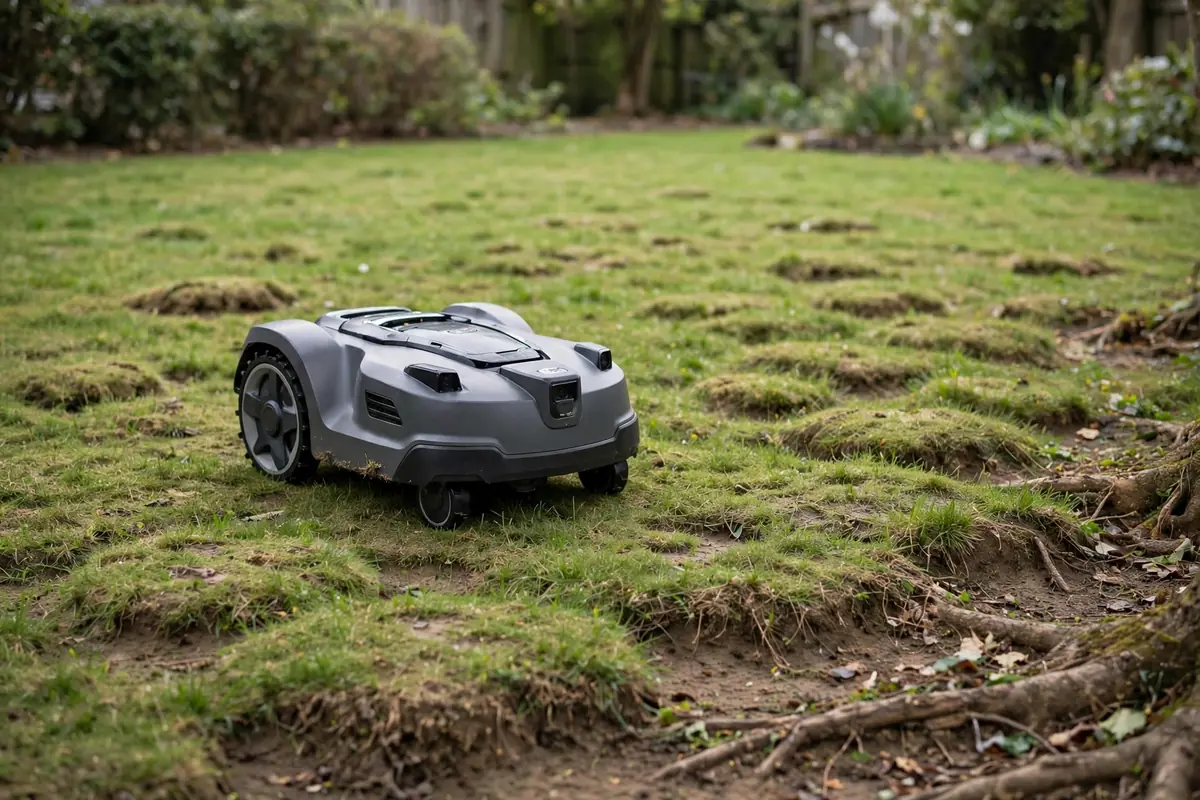
A robot mower for uneven ground needs good traction, enough ground clearance, a chassis that follows the shape of the lawn, and a cutting height that does not scalp the high spots. No single feature guarantees success on a bumpy lawn. The best choice depends on how uneven your lawn is, what causes the bumps, and whether you can reduce them before you buy.
Walk the lawn slowly and look at it the way a low, wheeled machine would. A lawn that looks rough may be easy for a mower with large drive wheels, while a mostly flat lawn can still stop one with a sharp ridge, a deep rut, a raised root, or a soft, wet hollow.
What “Uneven” Means for a Robotic Mower Uneven Lawn
“Uneven” covers several different problems. Rolling bumps and shallow dips are the most common, usually caused by settling soil, old turf, or foot traffic. A mower may rock or leave a slightly uneven cut, but it will often keep moving. Ruts are narrower and deeper, often left by a wheelbarrow or a heavy mower used when the soil was wet, and a small wheel can drop into one and spin.
Exposed roots can lift a wheel or catch a low blade disc, and they change as a tree grows. Holes and soft patches can make a wheel sink or tilt enough to stop. Sharp ridges and steps, such as a patio edge, are obstacles rather than bumps: they need a boundary or barrier, not a tougher mower. Walk the lawn after rain too, and mark the worst spots.
How to Choose a Robot Mower for Uneven Ground
Use the lawn you have just walked as your checklist. A mower that copes well on a gently rolling lawn may still struggle with deep ruts or high roots, while a mower built for rough ground may be unnecessary on a lawn that only needs a little levelling. Compare models against the specific problems you found, not a general idea of “rough” or “tough.”
The features below work together, so read the manual for any model you are considering. Terms such as “all-terrain” are marketing words, not standard measurements.
Robot Mower Traction: Wheels, Tyres and Weight
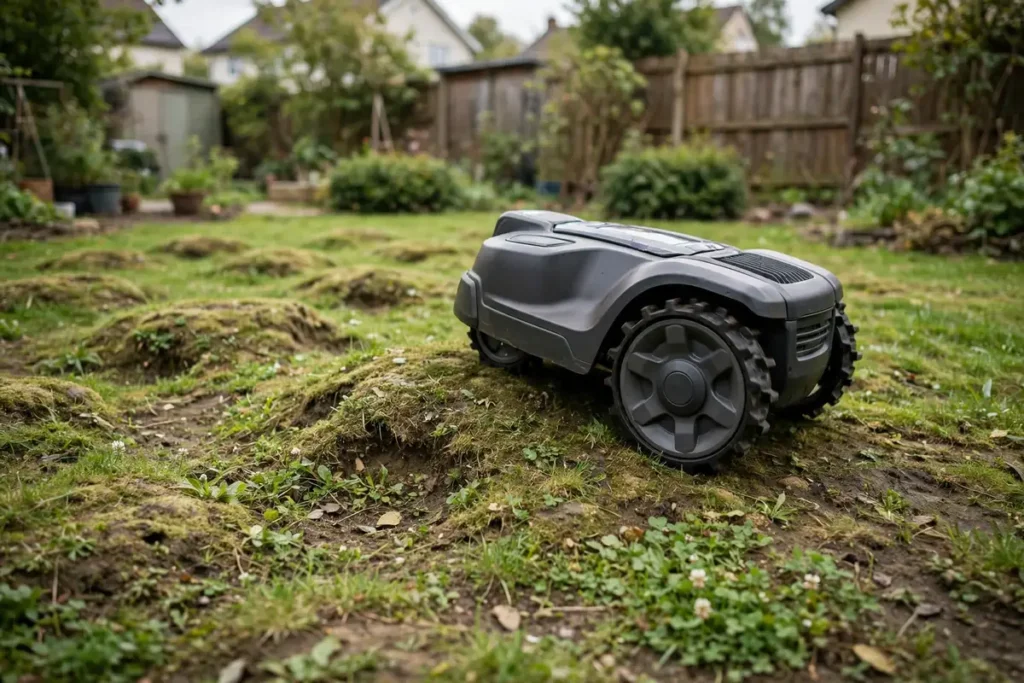
Robot mower traction is the first thing to check on a robot mower bumpy lawn. A mower that cannot grip cannot steer, climb a small rise, or get itself out of a dip. Traction comes from the drive wheels, the weight pressing them into the ground, and the surface they run on. A powerful motor does not help if the wheels are spinning.
Larger drive wheels roll over a small bump or root more easily than small wheels. Wider wheels spread the mower’s weight over more ground, which can help on soft soil. A deeper tread grips loose or damp grass better than a smooth wheel, though it can tear soft turf if the mower turns sharply in the same place. Check the wheel design in the manual, and whether replacement wheels are available.
Some mowers drive two wheels; others drive all four, which helps when one wheel lifts or loses grip. A heavier mower grips better on firm, dry ground but can sink on soft or wet ground, and wet grass makes traction worse, so check for a rain sensor or a setting that delays mowing after rain.
Safety note: Never lift, push, or pull a robot mower while its blades are running, and keep hands, feet, children, and pets away from the cutting disc. If a mower is stuck, stop it as described in its manual, wait for the blades to stop completely, and only then lift it clear. Do not bypass a safety sensor to keep a mower running on rough ground.
Robotic Lawn Mower Suspension and Chassis Flex
Robotic lawn mower suspension is not the same as car suspension. The idea is simpler: the wheels and body should move independently enough to keep the drive wheels in contact with uneven ground, without the cutting disc digging into a high spot or floating above a dip.
A pivoting or floating cutting deck lets the blade disc follow the ground more closely than a fixed deck, so the disc rises over a bump instead of scalping it. Check the manual to see whether the deck moves. Independent wheel movement helps too: if one wheel can rise over a root while the other stays on the ground, the mower is less likely to tip, spin, or stop. If the manual does not describe it, do not assume it is present.
Robot Mower Ground Clearance and Cutting Height
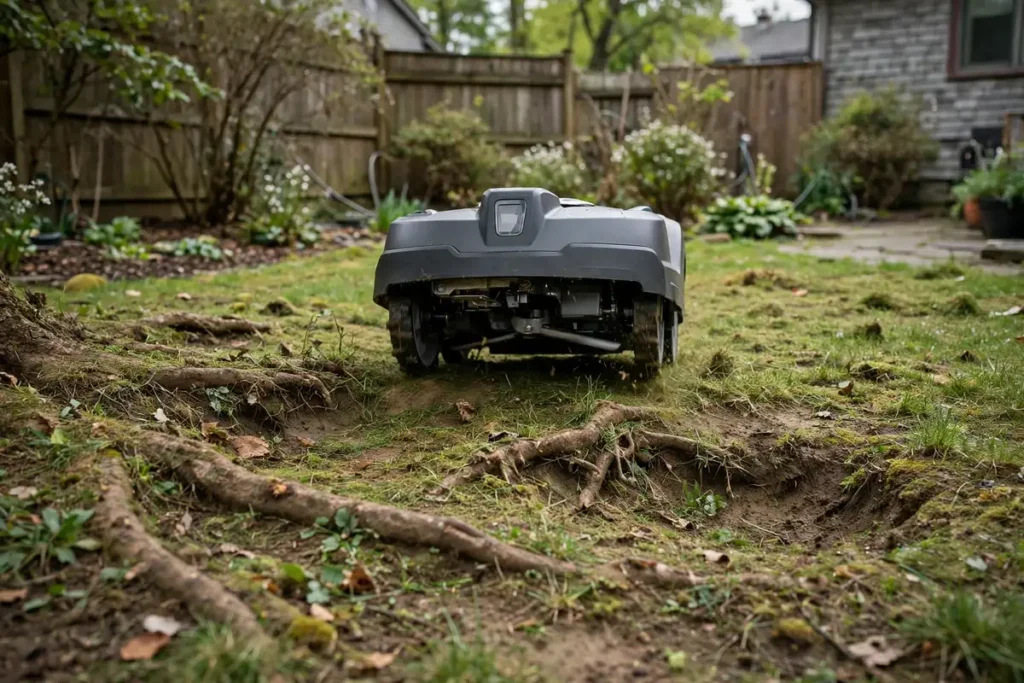
Robot mower ground clearance is the distance between the lowest part of the mower — often the blade disc, a skid, or the underside of the body — and the ground. It decides what the mower can pass over without catching. Cutting height is the height at which the blades cut the grass. The two are related, but they are not the same.
A mower that sits very close to the ground may cut neatly on a flat lawn, but it is more likely to catch on a raised root, a ridge, or a stone. A mower with more clearance can pass over small obstacles, though it may leave a less tidy cut if the deck floats too high over a dip. Check the manufacturer’s stated clearance in the manual, look underneath the mower for anything that hangs low, and keep the underside clean, because grass and mud build-up reduces clearance.
Cutting height protects the lawn as well as the mower. On a bumpy lawn, a very low cutting height increases the risk of scalping: cutting the grass down to the soil on top of a bump, while leaving the grass in a dip much longer. Scalped patches look pale, dry out quickly, and can invite weeds. A higher cutting height leaves more leaf, helps the grass recover, and gives the mower more room over small bumps. Start higher than you think you need, and lower it gradually if the cut looks even.
Navigation, Boundaries and Getting Stuck
Uneven ground can affect navigation as well as cutting: a mower that keeps getting stuck in the same hollow will not give a good result, however well it cuts when it is moving.
Boundary wire systems use a wire to mark the edge of the mowing area. The wire itself does not help with bumps, but the system is not affected by a wheel lifting briefly, and the wire must be laid so it is not damaged by edging, digging, or a wheel dropping into a rut. Wire-free systems use satellite positioning, cameras, or other sensors to map the lawn. They can be quicker to set up, but their accuracy can be affected by trees, buildings, and the mower’s position in a dip.
No-go zones and boundaries are your best tool for the worst spots. If there is a deep hole, high roots, a soft boggy patch, or a sharp step, exclude it from the mowing area rather than asking the mower to cross it. A mower that gets stuck is giving you information: note where it stops and whether it happens when the grass is wet. A single stuck spot is usually a lawn problem; repeated stopping in different places may point to a setting, a worn wheel, or a dirty sensor.
What to Check Before You Buy
- Walk and mark the lawn. Note bumps, dips, ruts, roots, holes, soft patches, and sharp steps.
- Check the drive wheels. Are they large, wide, and well treaded, and are two wheels or four driven?
- Check suspension. Does the deck float or pivot? Does an axle or chassis flex to keep wheels on the ground?
- Check ground clearance. What is the stated clearance, and what hangs lowest underneath?
- Check cutting height range. Can you cut high enough to avoid scalping the bumps?
- Check the manual. Does it mention bumps, roots, or rough ground?
- Check the dock location. Is there a flat, firm, level spot for the charging dock, with a clear approach?
- Check maintenance and parts. Are wheels, blades, and suspension parts easy to clean and replace?
Do not judge a mower only by a demonstration on a flat showroom lawn.
When Lawn Preparation Beats Buying a More Capable Mower
For many lawns, a little preparation is cheaper and more effective than buying a more capable mower. If the ground has deep holes, high roots, or sharp ridges, no wheel or suspension design will make those spots safe or easy to mow.
Topdressing — a thin layer of soil or sand worked into the low spots in the growing season — can gradually even out shallow dips. Fill ruts and holes with soil and reseed if the grass has died; never use stones or rubble, which can damage blades and wheels. Do not cut a large tree root: exclude it with a boundary or no-go zone, or cover it with mulch. Aerating compacted soil and improving drainage can also firm up soft, wet patches.
Lawn preparation is not always the answer: if the whole lawn is gently rolling, with no single bad spot, a mower with good traction, a floating deck, and enough clearance may be the right choice. If you rent, or have a large area with many small bumps, a more capable mower may be more practical than levelling the entire lawn.
Conclusion
A robot mower for uneven ground is not defined by a single feature or a marketing claim, but by how well its wheels, suspension, clearance, and cutting height work together on your lawn. Walk the lawn first, identify the bumps, dips, ruts, roots, and soft patches, and use those facts to compare models. Check the manual, set a higher cutting height to begin with, and use boundaries or no-go zones for the spots that no mower should cross.
In many cases, the best result comes from doing both things: fix the few worst spots, and choose a mower that can handle the gentle unevenness that remains. That gives a more even cut, fewer stops, and a healthier lawn, without paying for capability you do not need.
Frequently Asked Questions
Can a robot mower handle a bumpy lawn?
It depends on the lawn and the mower. Many handle gentle bumps and shallow dips, especially with large drive wheels, good traction, a floating deck, and enough clearance. Deep ruts, high roots, and holes are harder, and may need to be excluded with a boundary or no-go zone, or fixed first. Check the manual.
What cutting height should I use on a bumpy lawn?
Start higher than you would on a flat lawn, and lower the height gradually if the cut looks even and the mower is not catching. A higher cut reduces scalping, leaves more leaf to help the grass recover, and gives the mower more room over small obstacles.
Should I level my lawn before buying a robot mower?
Often, yes, at least for the worst spots. Filling holes and ruts, topdressing shallow dips, and excluding high roots can make a lawn much easier for any mower, and can be cheaper than buying a more capable model.
Why does my robot mower get stuck on uneven ground?
Common causes include a wheel dropping into a rut or hole, losing grip on wet or soft ground, or a low part catching on a root or ridge. Note where it stops and whether the grass is wet. If it is always the same spot, fix or exclude that spot. If it happens in different places, check the manual’s troubleshooting guidance and clean the wheels and sensors.