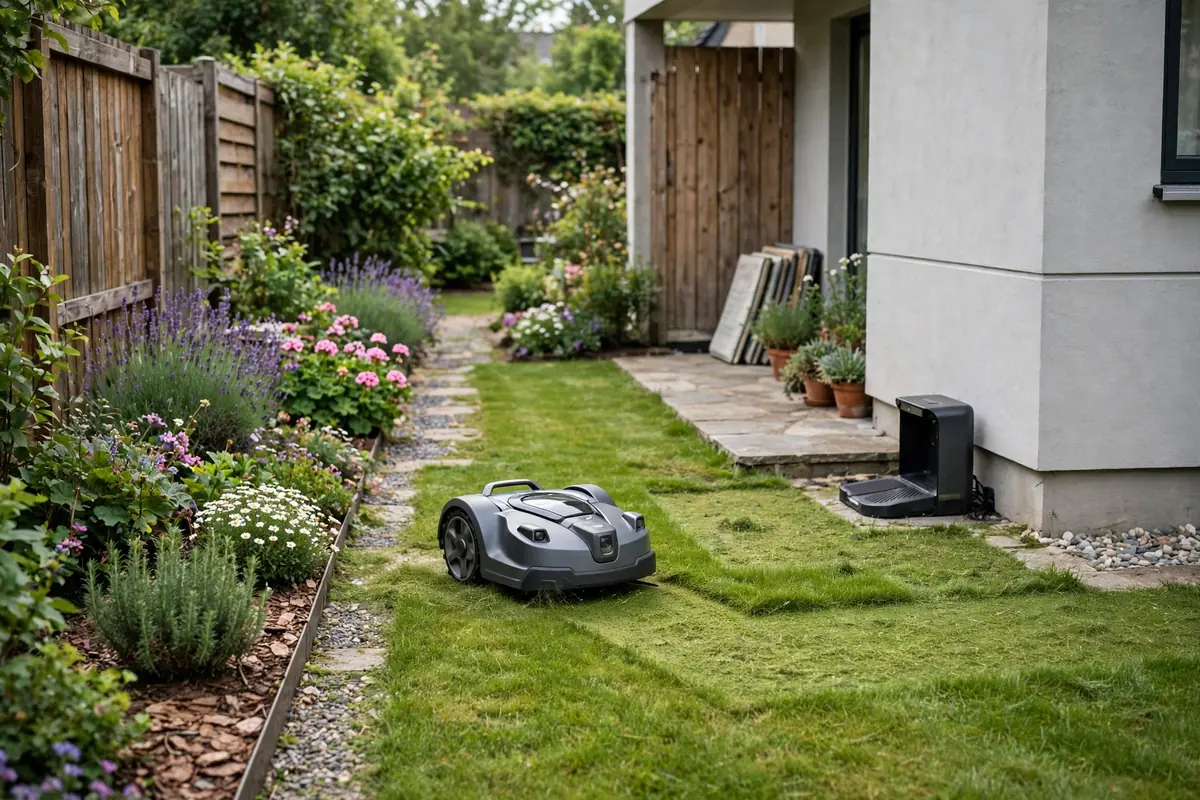
A robot mower for a small lawn should fit your garden, not just your lawn area. Choose a compact robotic lawn mower with enough small lawn mower coverage for the grass you actually have, a body narrow enough for your passages, and a dock that fits where you can put it. You do not need the largest capacity or the widest cut — but you do need a mower that can reach every part of the lawn.
A small lawn can still be awkward: split into front and back areas, broken up by beds and trees, or edged by a narrow side strip. This guide shows how to measure the real mowing area and judge the layout.
What Counts as a Small Lawn?
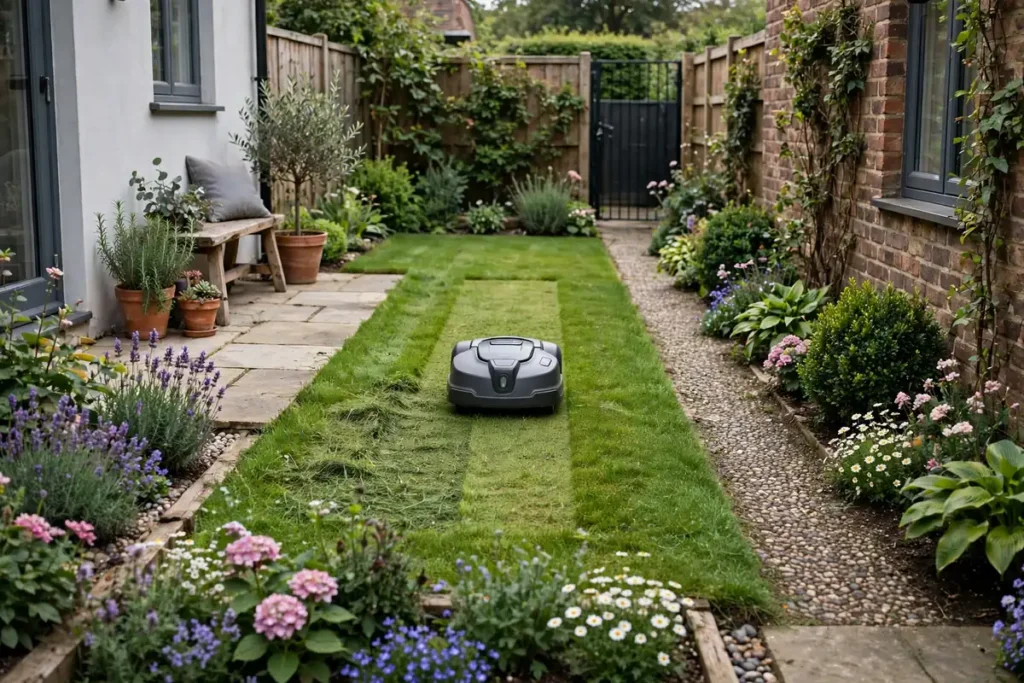
There is no single definition of a small lawn. For most homeowners, it is a front garden, a back garden, or both together. What matters more than a label is how much grass there is and how it is arranged.
A small, open, rectangular lawn is the easiest case. A lawn divided into two or three areas, with paths, beds, and a narrow side strip, is a different job. Ask three questions: how much grass is there, how is it divided up, and how will the mower get between parts and back to its dock?
Why a Small Lawn Needs a Different Choice
Buying the biggest mower you can afford can backfire on a small lawn. A larger mower is usually wider, heavier, and harder to store, and may need a larger dock and a wider passage to move between areas.
A compact model is easier to lift, clean, and store. It is more likely to fit through a gate or narrow strip, turn in a tight corner, and sit neatly beside a wall or patio. Its smaller cutting width is not a disadvantage here, because there is little open ground to cover quickly. What matters is whether it can finish the lawn in its normal schedule. A mower rated for a much larger area also usually costs more to buy and maintain, while that extra capacity sits unused.
Step 1: Measure Your Real Mowing Area
Measure the grass the mower will cut, not the size of your property. Exclude the house, driveway, patio, paths, beds, and pond. A small garden robot mower is sized by mowing area, so an inflated measurement pushes you toward a larger model than you need.
Walk the lawn with a tape measure and a simple sketch. For a rectangle, multiply length by width; for an irregular lawn, split it into rectangles and add them together. Measure each separate area as well as the total, check the manual for how a model handles separate areas, and keep the sketch for comparing models later.
Step 2: Robot Mower for Small Lawn — Layout, Passages, and Obstacles
For a robot mower for small yards, layout is often more important than area. Narrow passages are the most common problem. Measure the narrowest point of every corridor, gate, and strip — not the widest point or the average — including edging and plant pots at ground level. Then check the specific model’s manual for its minimum passage width. If a passage is too narrow, the mower may not reach the area beyond it, or may get stuck trying.
Check corners and turns too, and list fixed obstacles such as trees and garden furniture, which need a boundary, barrier, or no-go zone. Pick up hoses, cables, toys, and pet waste before mowing. For steps, ponds, and drops, check how the model detects edges, and never rely on it to stop safely at a drop unless the manual says it is designed to do so.
Step 3: Choose the Right Small Lawn Mower Coverage
Small lawn mower coverage is not just the headline area on the box. That figure is usually a maximum under favourable conditions, and real coverage depends on lawn shape, obstacles, slopes, grass growth, and weather. A mower rated for a larger area is not automatically better.
Choose a mower whose rated area comfortably covers your measured area, with a modest margin for shape and obstacles. Then check the other limits that matter: minimum passage width, maximum slope, and how it handles separate zones. A model that passes on area but fails on passage width is the wrong model. Avoid buying several times more capacity than you need: a much larger mower will usually be bigger, heavier, more expensive, and harder to manoeuvre.
If two models both cover your area, choose the one that fits your layout and storage better, not the one with the bigger headline number.
Step 4: Pick a Compact Size and Cutting Width
A compact mower is easier to carry to a separate area if the model allows that, easier to lift for cleaning, and easier to store in a shed or garage.
A wider cut covers open ground faster, but needs more room to turn and pass through gaps. A narrower cut fits a complex small garden better, and on a small lawn the time saved by a wider cut is usually small. Check the mower’s overall width, not just its cutting width, against your narrowest passage. Follow the manual’s shutdown and lifting instructions, and never lift a mower while its blades are running.
Step 5: Choose Navigation and Boundaries for a Complex Small Garden
A boundary wire system uses a wire around the edge of the mowing area, and sometimes around beds to exclude them. Installation takes more time at first, but the boundary is fixed and does not depend on satellite or camera signals — an advantage in a garden surrounded by fences, walls, and trees. Wire can be damaged by edging tools or digging, so allow time for occasional checks.
A wire-free system uses satellite positioning, cameras, or other sensors to map the lawn and create virtual boundaries. It can be quicker to set up and easier to adjust, but performance depends on the technology, sky visibility, and how the map is created. Check how the specific model handles narrow passages and separate zones, and whether it stops safely if the signal is lost.
Safety note: Keep children and pets away from a working mower. Blades are sharp, even when they look small, so switch the mower off and follow the manual’s shutdown steps before cleaning, lifting, or changing blades. Do not bypass safety features.
Step 6: Plan Dock Placement and Storage Before You Buy
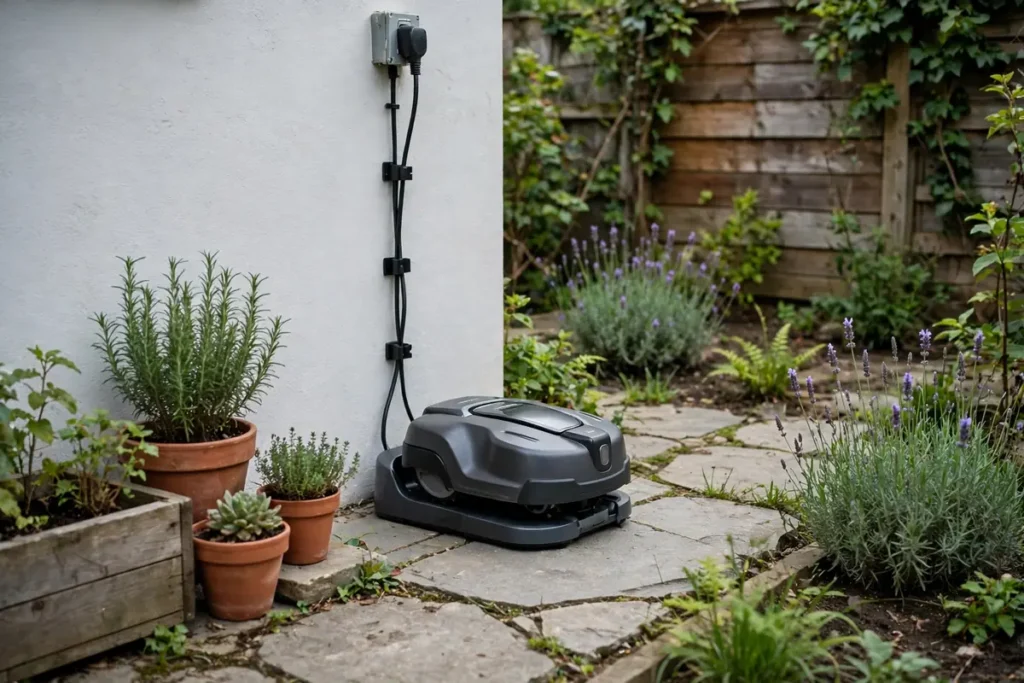
On a small lawn, the dock is often the hardest part to place. It needs power, level ground, a clear approach, and enough space for the mower to enter and leave without hitting a wall, fence, or plant pot. It should also be reachable for maintenance, and not block a path.
Before you buy, find two or three possible dock locations and check each against the manual for clearance, level ground, and shelter. A spot that looks convenient may fail on clearance, while a less obvious spot beside a wall or patio may work well. Measure your storage against the mower and dock dimensions, and check the route from the dock to each mowing area. Do not run an extension lead across a lawn or path as a permanent solution, and do not modify the power supply or dock. If you are unsure about the electrical work, ask a qualified electrician.
Features Worth Paying For — and Ones You Can Skip
Features often worth having include adjustable cutting height, a rain sensor or rain delay if your lawn stays damp, obstacle detection, and a simple schedule. App control can be useful, but it is not essential if the mower has clear on-board controls. A lift or tilt sensor, which stops the blades if the mower is lifted, is a safety feature — check that it is present and do not bypass it.
You may not need a very large battery, a very wide cut, advanced mapping for many zones, or a large dock shelter. Do not pay a premium for a feature you cannot name a use for, and check noise, spares, and warranty before you buy.
A Short Decision Checklist for a Small Lawn
- Measure and sketch. Record each area, with passages, obstacles, slopes, and dock options.
- Check passages. Measure the narrowest point of every passage and compare it with the manual’s minimum width.
- Check coverage. Choose a mower whose rated area comfortably covers your measured area.
- Check size and storage. Compare the mower and dock dimensions with your passages and storage.
- Check navigation. Confirm the system can handle your zones, passages, and no-go areas.
- Check the dock. Confirm power, level ground, clearance, and a clear route to each mowing area.
- Check safety and service. Confirm lift and tilt safety features, spares, warranty, and support.
- Shortlist two or three models. Compare them on fit, not headline capacity.
If no model passes all eight steps, the problem may be the layout, not the mower. A very narrow passage or a dock with no power may need a garden change or a different dock location — better to find that out before you buy.
Conclusion
Choosing a robot mower for a small lawn is not about finding the smallest mower, or the largest one you can afford. It is about finding a compact robotic lawn mower that fits your measured area, your narrow passages, your dock space, and your storage. Measure first, sketch the layout, and check passage widths and dock clearance against the manual. Choose enough small lawn mower coverage for your lawn, with a modest margin, and resist paying for far more capacity than you will use.
Frequently Asked Questions
What size robot mower do I need for a small lawn?
Choose by your measured mowing area, not the size of your property. Add up each grass area, choose a mower whose rated area comfortably covers that total, then check the manual for passage width, slope, and separate areas.
Can a robot mower handle a narrow side passage?
It depends on the passage and the model. Measure the narrowest point, including edging, posts, and plant pots, and compare it with the minimum passage width in the specific model’s manual. If the passage is too narrow, the mower may not reach the area beyond it, or may get stuck.
Is a compact robotic lawn mower powerful enough for a small garden?
For most small gardens, yes, provided its rated area covers your lawn and it can handle your layout, slopes, and grass growth. A compact mower is usually narrower, lighter, and easier to store and manoeuvre. Check that it can finish your lawn within its normal routine, including charging time.
Do I need a wire-free mower for a small lawn?
Not necessarily. A boundary wire system can work well in a small garden surrounded by fences, walls, and trees, because the boundary is fixed and does not depend on signals. A wire-free system can be quicker to set up and easier to adjust, but its performance depends on the technology and mapping.
Where should I put the charging dock on a small lawn?
Put it where it has power, level ground, the clearance stated in the manual, and a clear route to each mowing area. Do not place it where it blocks a path or creates a trip hazard. If you have no suitable spot with power, sort that out before you buy.
How do I avoid overspending on a robot mower for a small lawn?
Measure your lawn, buy enough coverage for that area with a modest margin, and do not pay for several times more capacity than you need. Compare models on fit — passage width, dock size, storage, and navigation — rather than headline area or battery size.