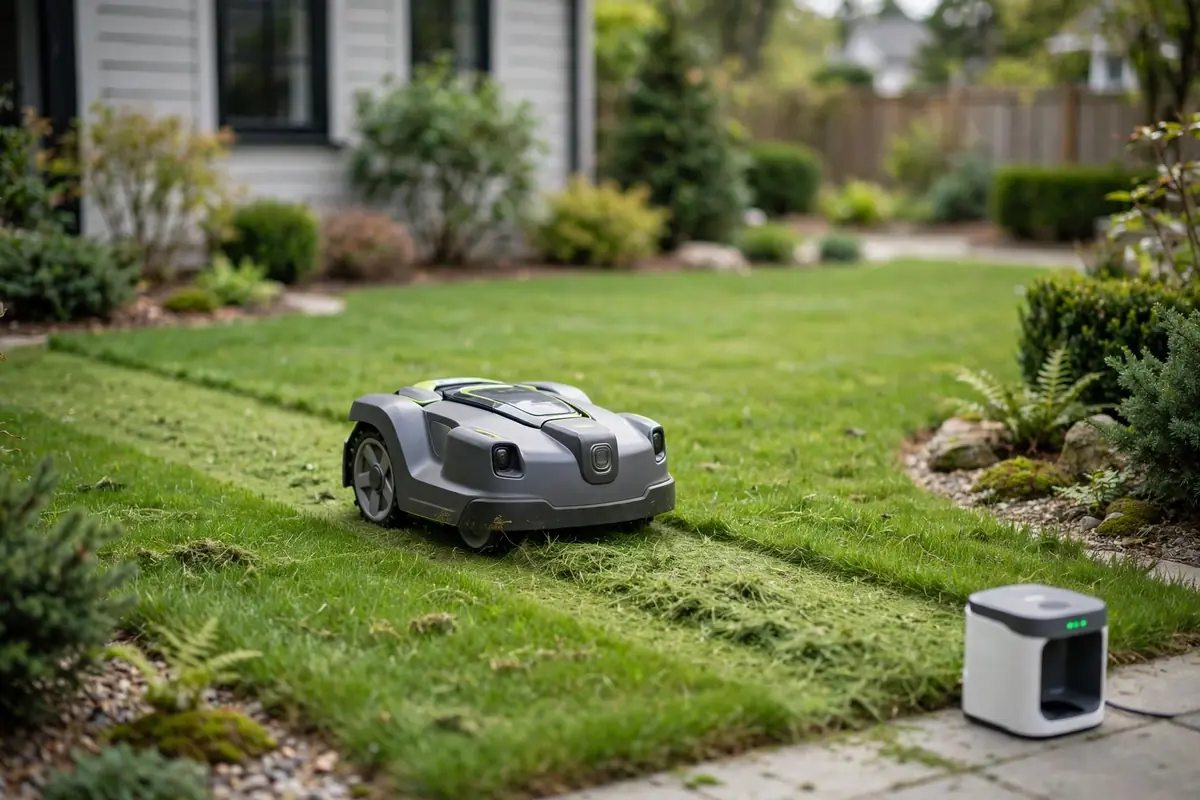
Choosing a robotic lawn mower starts with your yard, not a product page. The right mower matches your lawn size, shape, slopes, obstacles, and how much setup and maintenance you will do. A mower with a larger headline area rating will not help if it cannot handle your narrow passages, steep sections, or tree roots.
This robot mower buying guide shows how to choose a robot lawn mower, including the main robotic mower requirements. Measure your lawn, note its awkward spots, compare models against those facts, then shortlist two or three options and check each model’s manual before you buy.
How to Choose a Robot Lawn Mower in 7 Steps
Work through these steps in order. Each one narrows the choice.
Step 1: Measure your lawn properly
Measure the area the mower will actually cut, not the size of your whole property. Exclude the house, driveway, patios, paths, flower beds, vegetable garden, pond, and areas you do not want mowed.
Sketch the lawn and mark separate areas, passages, trees, beds, and the likely dock location. For a rectangular lawn, multiply length by width; for an irregular one, break it into rectangles and add them together. Check app estimates with a tape measure.
Note shaded, damp, or fast-growing areas too, as they affect mowing frequency.
Step 2: Map the layout, passages, and obstacles
Layout matters as much as size. An open lawn is easy for most mowers; a lawn split into areas by narrow passages, trees, or raised beds is harder.
Measure any corridor, gate, or strip of grass, and check the manual for its minimum passage width. Note fixed obstacles such as trees and furniture, and clear loose hoses, cables, toys, and branches before mowing.
Note steps, walls, ponds, and drops too. These need a boundary, barrier, or no-go zone. Find a dock location with power, level ground, and a clear approach.
Step 3: Check slopes, uneven ground, and traction
Check the steepest part of your lawn, not just the average. A short, steep bank can be harder than a gentle slope across the whole lawn.
Manufacturers usually state a maximum slope as a percentage or in degrees, measured under ideal, dry conditions. Wet grass, loose soil, and worn wheels reduce traction, so leave a margin above your steepest section. Check the manual for how slope should be measured.
Bumps, dips, roots, and ruts can lift wheels or cause a mower to get stuck. Filling holes and levelling small dips may help more than buying a more capable mower.
Safety note: Never use a robot mower on a slope that feels unsafe to walk on, and never lift or reposition it while its blades are running. Keep children and pets away while it works.
Step 4: Decide on a boundary and navigation system
Boundary wire systems use a wire around the lawn edge, and sometimes around beds, to mark the mowing area. Installation takes longer at first, but the boundary is fixed and does not depend on satellite or camera signals. Wire can be damaged by edging tools or digging, so allow time for occasional checks.
Wire-free systems use satellite positioning, cameras, or other sensors to map the lawn and create virtual boundaries. They can be quicker to set up and easier to adjust, but performance depends on the technology, sky visibility, nearby buildings and trees, and mapping. Not all wire-free systems work the same way.
Some mowers use simpler navigation and cover the lawn over time; others map it and mow in straighter lines. Check how the boundary is created and changed, whether you can add no-go zones, and what happens if the signal is lost.
Step 5: Compare cutting width, cutting height, and battery
A wider mower covers open ground faster but may struggle in narrow passages. A narrower mower fits a complex garden better. Choose width for your layout, not just speed.
Cutting height matters for grass health. Choose a range that fits your grass type and season, and check how height is adjusted. Cutting too low can scalp the lawn, especially on uneven ground.
A larger battery does not automatically suit a large lawn. Mowing time also depends on width, speed, grass density, slopes, and charging returns. Many mowers work in cycles — mow, charge, then continue — so check whether it can finish within your daily schedule.
Safety note: Robot mower blades are sharp, even when they look small. Switch the mower off and follow the manual’s shutdown steps before cleaning, lifting, or changing blades. Do not bypass safety switches.
Step 6: Think about weather, noise, pets, and children
Check how the model responds to rain. Some pause or return to the dock, some continue in light rain, and some use an adjustable rain sensor. Mowing wet grass can clog the underside, reduce cut quality, and make slopes slippery, so a mower that waits for drier conditions may suit a damp or shaded lawn.
Teach children not to ride on, chase, or lift a working mower. Keep pets elsewhere if your manual advises it, and pick up pet waste, toys, and cables before each run. Protect ponds and play areas with a boundary or no-go zone.
Step 7: Work out the total budget, not just the purchase price
List the likely ongoing costs before you decide: installation materials such as wire, pegs, or a reference station; replacement blades and other consumables; electricity for charging; battery replacement in the longer term; repairs and servicing, if available locally; and accessories such as a dock shelter.
Check warranty length, cover, and local service and parts availability. A lower price can mislead if blades, batteries, or repairs are costly or hard to obtain. Set a budget range and compare models on fit first, then features.
Robot Mower Features That Actually Matter
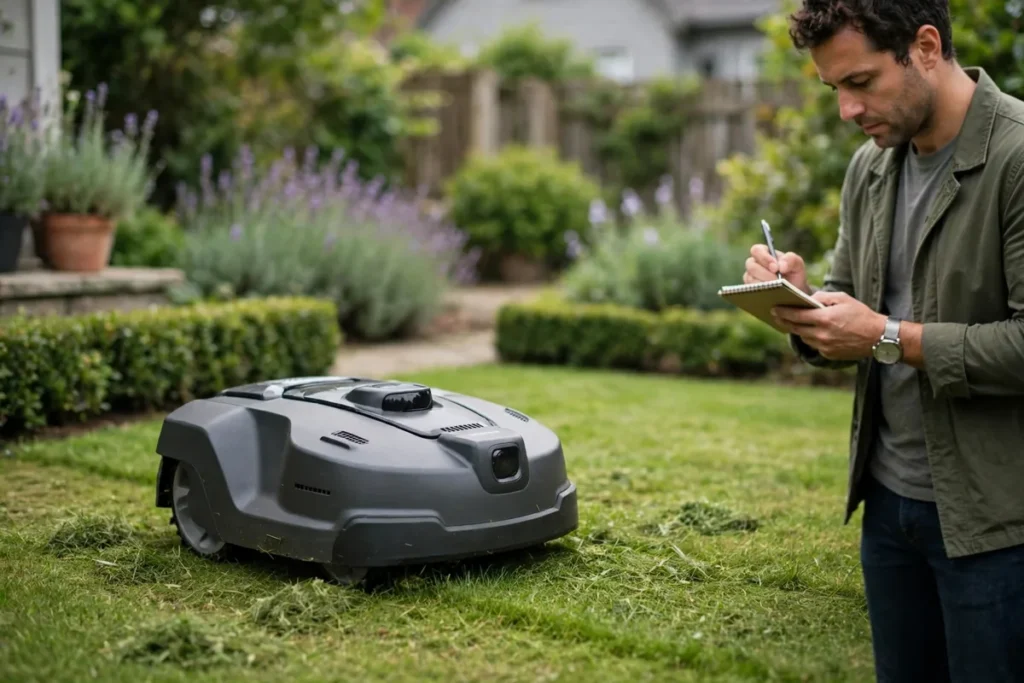
Only some robot mower features change the result. Use this table to separate essentials from conveniences.
| Feature | Why it matters | When it matters most |
|---|---|---|
| Adjustable cutting height | Protects grass and adapts to seasons | Uneven or fast-growing lawns |
| Rain sensor or delay | Avoids wet mowing that clogs the mower | Damp, shaded lawns |
| Obstacle detection | Helps the mower steer around objects | Lawns with trees, toys, or pets |
| Mapping and zones | Planned coverage and no-go areas | Large, split, or complex lawns |
Convenience features such as voice control can be useful, but they should not outweigh fit. Choose essentials first, then use extras as a tie-breaker.
Lawn Size for Robot Mower: How Much Capacity Do You Really Need?
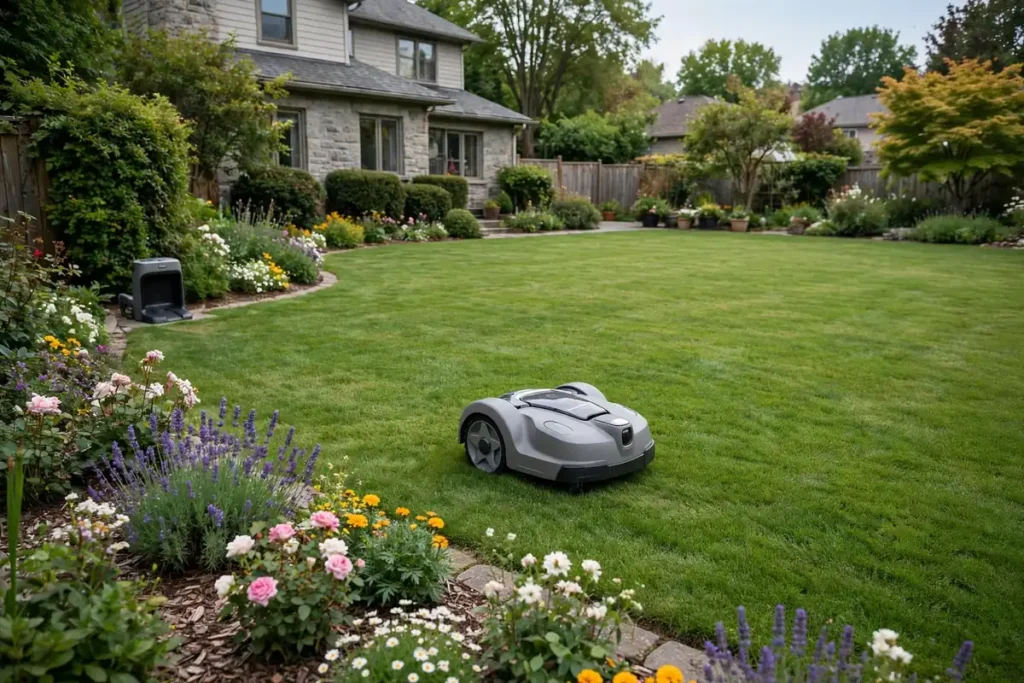
Manufacturer area ratings are a starting point, not a guarantee. A rating usually describes the maximum area a mower can maintain under favourable conditions.
Shape and obstacles reduce effective capacity. A square, open lawn is easier to cover than a long, narrow one with beds, trees, and passages. In spring and early summer, more frequent mowing leaves less spare time, and weather and charging also reduce cutting time.
Do not choose a mower whose maximum area is only just above your lawn size. Leave headroom for faster growth, a complex shape, and days when it cannot run. If you are between two sizes, the larger capacity is often safer — if it still fits your passages, slopes, and dock location.
Choosing a Robotic Lawn Mower: Boundary Systems Compared
| System | Setup effort | Flexibility | Main limitation |
|---|---|---|---|
| Boundary wire | Higher at first | Fixed boundary | Wire can be damaged |
| Wire-free, satellite-based | Lower physical setup | Easy to adjust zones | Needs a clear sky view |
| Wire-free, camera-based | Lower physical setup | Easy to adjust zones | Varies with light and layout |
| Simpler, non-mapped | Usually lower | Less zone control | Less predictable coverage |
No system is best for every garden. A wired system may suit a stable garden; a wire-free system may suit one where beds or play areas change often, if signal conditions allow. Do not assume two wire-free mowers use the same technology.
Common Mistakes When Choosing a Robotic Lawn Mower
- Buying on area rating alone. A mower rated for your exact lawn size may still struggle on a complex, steep, or fast-growing lawn.
- Ignoring passages and separate areas. A mower that cannot reach a narrow section will leave part uncut.
- Forgetting the dock. Check for power, level ground, and a clear approach before you buy.
- Overlooking maintenance. Blades, cleaning, wheels, and charging contacts are part of ownership.
- Skipping the manual. Slope limits, passage widths, and safety steps vary by model.
A Simple Decision Framework Before You Buy
Compare your shortlist against these checks. If a model fails a must-have item, remove it.
- Lawn size and shape: Enough capacity, with headroom?
- Slopes and ground: Steepest slope within the limit, with a margin?
- Passages and areas: Can it reach every area and pass the narrowest passage?
- Boundary system: Does it suit your garden and setup effort?
- Cutting and battery: Do width, height range, and schedule fit?
- Weather and safety: Does it handle rain, obstacles, pets, and children?
- Dock and power: Suitable dock location with power and a clear approach?
- Total cost and support: Installation, blades, electricity, battery, and servicing included?
- Maintenance: Can you clean it, change blades, and check wheels safely?
If two models pass, choose the easier to install and maintain, and better supported locally.
Conclusion
Learning how to choose a robot lawn mower is mostly about learning your own yard. Measure the lawn, map its layout, check slopes and passages, choose a suitable boundary system, and compare cutting, battery, weather, and safety features. Then work out the total cost before you decide.
Do not let a single specification decide it. A mower that fits your lawn and schedule will give a tidier lawn with less effort than a more powerful model that struggles with awkward spots. Shortlist two or three models and choose the one that passes your checklist with the clearest margin.
Frequently Asked Questions
What size robot mower do I need for my lawn?
Measure the area you actually want mowed, excluding paths and beds. Choose a mower with capacity above that figure, leaving headroom for shape, obstacles, slopes, and faster growth.
How do I know if my lawn is too steep for a robot mower?
Find your steepest section and compare it with the model’s stated maximum slope, using the same units. Leave a margin, because wet grass and uneven ground reduce traction.
Is a wire-free robot mower better than a boundary wire mower?
Neither is better for every garden. Wire-free systems can be quicker to set up and easier to adjust, but they depend on navigation technology and signal conditions. Wired systems take longer to install, but the boundary is fixed.
How long does a robot mower take to mow a lawn?
It depends on lawn size, shape, cutting width, grass growth, slopes, and charging returns. Many mowers work in cycles over several hours. Allow time for charging, rain delays, and obstacles.
Do robot mowers work in the rain?
Some pause or return to the dock in rain, while others continue in light rain. Mowing wet grass can reduce cut quality and make slopes slippery, so many owners prefer a rain sensor or delay. Avoid heavy rain or standing water.
What maintenance does a robot mower need?
Clean grass and debris from the underside and wheels, inspect and replace blades when worn, check charging contacts, and follow the manual’s storage and battery guidance. Always switch it off before cleaning or changing blades. Do not pressure-wash it unless the manufacturer explicitly permits it.